Contract Manufacturer vs OEM Differences | Best Manufacturing Model in USA

May 21, 2026
Auto Parts
Contract Manufacturer vs OEM Differences | Best Manufacturing Model in USA

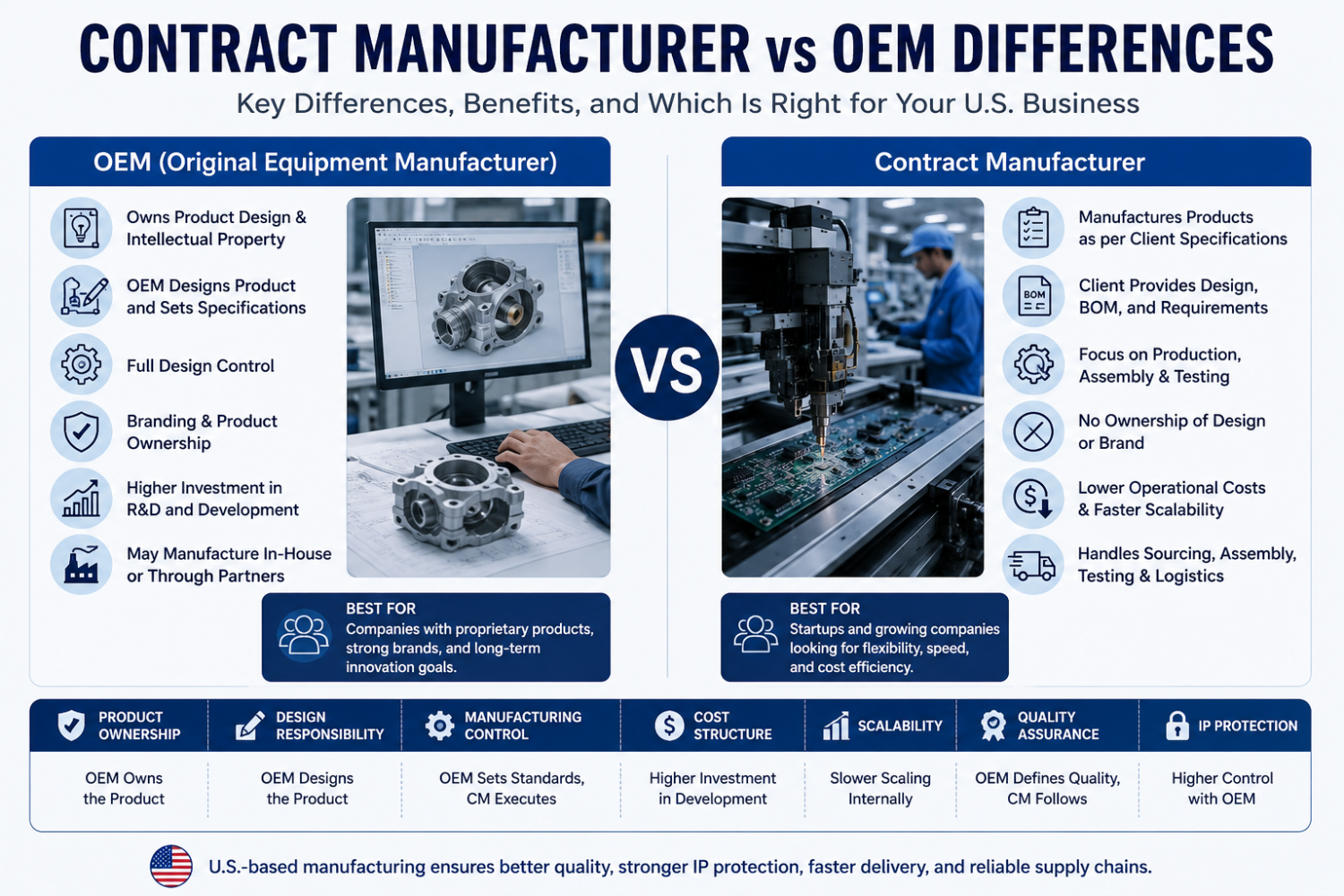
Understanding the differences between a contract manufacturer and an OEM is essential for U.S. businesses that want to reduce production costs, protect intellectual property, and improve manufacturing efficiency. While an Original Equipment Manufacturer (OEM) owns the product design and branding, a contract manufacturer focuses on building the product according to client specifications.

As American companies strengthen domestic supply chains and improve production flexibility, selecting the right manufacturing model can directly impact quality, scalability, and profitability. This guide explains the major contract manufacturer vs OEM differences, including ownership, production control, compliance, scalability, and cost structure.


What Is OEM Manufacturing?

An Original Equipment Manufacturer (OEM) is a company that designs, develops, and owns a product’s intellectual property, specifications, and branding. OEMs typically control product architecture, engineering standards, and performance requirements before production begins.

OEM manufacturing is widely used across U.S. industries such as:

IndustryOEM Manufacturing Usage
Medical DevicesDiagnostic equipment
AutomotiveElectronic control units
AerospaceNavigation systems
Consumer ElectronicsSmart devices
Industrial AutomationRobotics & control systems

How OEM Manufacturing Works

In an OEM model:

  • The company develops the product concept
  • Engineering teams create specifications
  • The OEM designs product functionality
  • Production may occur internally or through suppliers
  • The OEM controls branding and distribution

This model provides complete authority over innovation and product differentiation.

Advantages of OEM Manufacturing

Full Product Ownership

OEMs own:

  • Product design
  • Intellectual property
  • Engineering documentation
  • Branding assets

This allows companies to protect proprietary technology and maintain long-term competitive advantages.

Full Design Control

OEMs maintain direct oversight of:

  • Product quality
  • Technical specifications
  • Performance standards
  • Product innovation

Competitive Product Differentiation

OEM manufacturing allows businesses to create unique products tailored to their target markets.

Strong Brand Identity

Products are fully aligned with company branding, improving customer trust and market recognition.

Challenges of OEM Manufacturing

Despite its benefits, OEM manufacturing also presents several challenges:

  • Higher R&D investment
  • Longer development timelines
  • Need for specialized engineering teams
  • Complex supply chain management
  • Greater operational costs

These factors are critical when comparing contract manufacturer vs OEM differences.

What Is Contract Manufacturing?

Contract manufacturing is the process of outsourcing production to a third-party company that manufactures products according to the client’s specifications.

Unlike OEMs, contract manufacturers do not typically own the product design or branding.

How Contract Manufacturing Works

A contract manufacturer may handle:

  • PCB assembly
  • Component sourcing
  • Product assembly
  • Quality testing
  • Packaging
  • Logistics support

Meanwhile, the client retains ownership of the intellectual property and product concept.


Contract Manufacturer vs OEM Differences

Understanding the major contract manufacturer vs OEM differences helps businesses select the best production strategy.

Quick Comparison Chart

FactorOEMContract Manufacturer
Product OwnershipOwns design & IPManufactures product
EngineeringInternalClient-provided
BrandingOEM controls brandingNo branding ownership
ProductionInternal or outsourcedThird-party production
InvestmentHigh upfront costsLower infrastructure costs
ScalabilitySlower scalingFaster scaling
IP ProtectionHigher controlShared responsibility


Product Ownership

One of the biggest contract manufacturer vs OEM differences is ownership.

OEM Ownership Includes:

  • Product design
  • Intellectual property
  • Branding
  • Engineering files

Contract Manufacturer Role:

  • Produces products according to provided specifications
  • Does not own product rights
  • Focuses on operational execution

Ownership directly affects innovation, licensing, and long-term business value.


Design Responsibility

In an OEM model, the company internally manages:

  • Product architecture
  • Engineering
  • Performance optimization
  • Product functionality

Contract manufacturers mainly focus on:

  • Assembly
  • Production efficiency
  • Manufacturing execution

This distinction significantly impacts product customization and innovation capability.

Manufacturing Control

OEMs generally maintain stronger oversight of:

  • Quality standards
  • Production methods
  • Compliance requirements
  • Supplier management

Contract manufacturers may execute production, but the OEM typically retains strategic authority over the product.

Cost Structure Comparison

Cost is another major factor in contract manufacturer vs OEM differences.

OEM Costs Include:

  • Product development
  • Engineering salaries
  • Equipment investment
  • Testing and certifications
  • Internal labor

Contract Manufacturing Costs Include:

  • Production outsourcing
  • Assembly services
  • Component sourcing
  • Manufacturing labor

For many startups and mid-sized U.S. companies, contract manufacturing significantly reduces capital investment.

Why U.S.-Based Contract Manufacturing Is Growing

American manufacturing is experiencing renewed growth as companies improve domestic supply chain reliability.

Supply Chain Stability

Domestic production offers:

  • Faster shipping
  • Better communication
  • Reduced delays
  • Lower geopolitical risk

Better Intellectual Property Protection

U.S.-based manufacturing provides stronger legal safeguards for proprietary technology.

Faster Time-to-Market

Domestic manufacturers support:

  • Rapid prototyping
  • Faster engineering collaboration
  • Quicker production adjustments

These advantages are especially important for electronics companies operating in competitive industries.

OEM vs Contract Manufacturer: Which Is Better?

The right choice depends on business goals, product complexity, and production requirements.

OEM Is Best For:

  • Proprietary technology
  • Premium branded products
  • High customization
  • Long-term innovation strategies

Contract Manufacturing Is Best For:

  • Faster scaling
  • Lower operational costs
  • Flexible production capacity
  • Startups and growing businesses

Many successful U.S. companies now combine both models for maximum efficiency.

Key Benefits of U.S. Electronics Contract Manufacturing

Reduced Capital Investment

Businesses avoid expensive factory setup and infrastructure costs.

Access to Advanced Equipment

Modern U.S. manufacturers often provide:

  • Automated SMT lines
  • Precision PCB assembly
  • Advanced inspection systems
  • Automated testing equipment

Improved Compliance Standards

American manufacturers commonly follow:

  • ISO certifications
  • IPC standards
  • FDA regulations
  • Aerospace quality standards

Engineering Support

Many contract manufacturers also offer:

  • DFM analysis
  • BOM optimization
  • Prototype development
  • Process engineering support

Manufacturing Workflow Comparison

Manufacturing StepOEM ResponsibilityContract Manufacturer Responsibility
Product ConceptYesNo
Engineering DesignYesLimited
Component SourcingSharedYes
AssemblySometimesYes
TestingSharedYes
BrandingYesNo
LogisticsSharedShared

This workflow clearly highlights the operational contract manufacturer vs OEM differences that influence production efficiency.

How to Choose the Right Manufacturing Partner in the USA

Selecting the right manufacturing partner requires careful evaluation.

Technical Capabilities

Look for manufacturers with expertise in:

  • PCB assembly
  • Box-build assembly
  • Automated production
  • Functional testing

Certifications

Choose partners with certifications such as:

  • ISO 9001
  • IPC certifications
  • AS9100 (aerospace)
  • ISO 13485 (medical devices)

Scalability

A good manufacturing partner should support:

  • Prototyping
  • Low-volume production
  • High-volume manufacturing

Communication & Collaboration

Strong engineering communication helps reduce:

  • Design errors
  • Production delays
  • Quality inconsistencies

Why Hybrid Manufacturing Models Are Growing

Many American businesses now combine OEM and contract manufacturing models.

In this approach:

  • The OEM retains innovation and ownership
  • The contract manufacturer handles production and logistics

This strategy balances:

  • Innovation
  • Cost efficiency
  • Scalability
  • Operational flexibility

Hybrid partnerships are becoming increasingly common across the U.S. electronics industry.

Common Manufacturing Mistakes Businesses Make

Choosing Based Only on Cost

Low-cost production can lead to:

  • Quality problems
  • Compliance failures
  • Delays
  • Rework expenses

Ignoring Supply Chain Risks

Global disruptions can severely impact overseas manufacturing operations.

Weak Communication

Poor collaboration often causes:

  • Assembly errors
  • Engineering conflicts
  • Production inefficiencies

Overlooking Scalability

Manufacturers must support future growth and changing production volumes.


Frequently Asked Questions (FAQ)

What is the biggest difference between a contract manufacturer and an OEM?

The biggest difference is ownership. An OEM owns the product design and intellectual property, while a contract manufacturer produces products according to client specifications.

Can contract manufacturers assist with product design?

Yes. Many contract manufacturers provide engineering support, DFM analysis, and prototyping services.

Is contract manufacturing cheaper than OEM production?

In many cases, yes. Contract manufacturing reduces infrastructure and operational expenses.

Why are U.S.-based manufacturers becoming more popular?

American manufacturers offer stronger quality control, faster shipping, better communication, and improved IP protection.

What industries commonly use OEM manufacturing?

Industries include:

  • Electronics
  • Aerospace
  • Automotive
  • Medical devices
  • Industrial automation

Does contract manufacturing reduce product quality?

Not necessarily. Reputable U.S. manufacturers follow strict quality and compliance standards.

Why is scalability important in manufacturing?

Scalable production allows companies to grow efficiently without rebuilding infrastructure.

How do companies protect intellectual property?

Businesses use:

  • NDAs
  • Patent protections
  • Legal agreements
  • Secure domestic manufacturing partnerships

Final Thoughts

Understanding the key contract manufacturer vs OEM differences is essential for businesses looking to improve product quality, reduce manufacturing risks, and scale efficiently in the U.S. market.

An OEM model provides stronger brand ownership, full design control, and greater innovation opportunities. Contract manufacturing, on the other hand, offers flexibility, lower operational costs, and faster production scalability.

Today, many successful American electronics companies combine both approaches to achieve the ideal balance between innovation and manufacturing efficiency.

Whether your business is launching a new product or optimizing an existing supply chain, selecting the right manufacturing strategy can significantly impact long-term profitability, operational efficiency, and market competitiveness.

Home
All categories
Flash Sale
Todays Deal
Warranty & Returns Policy
Terms & Conditions
WhatsApp